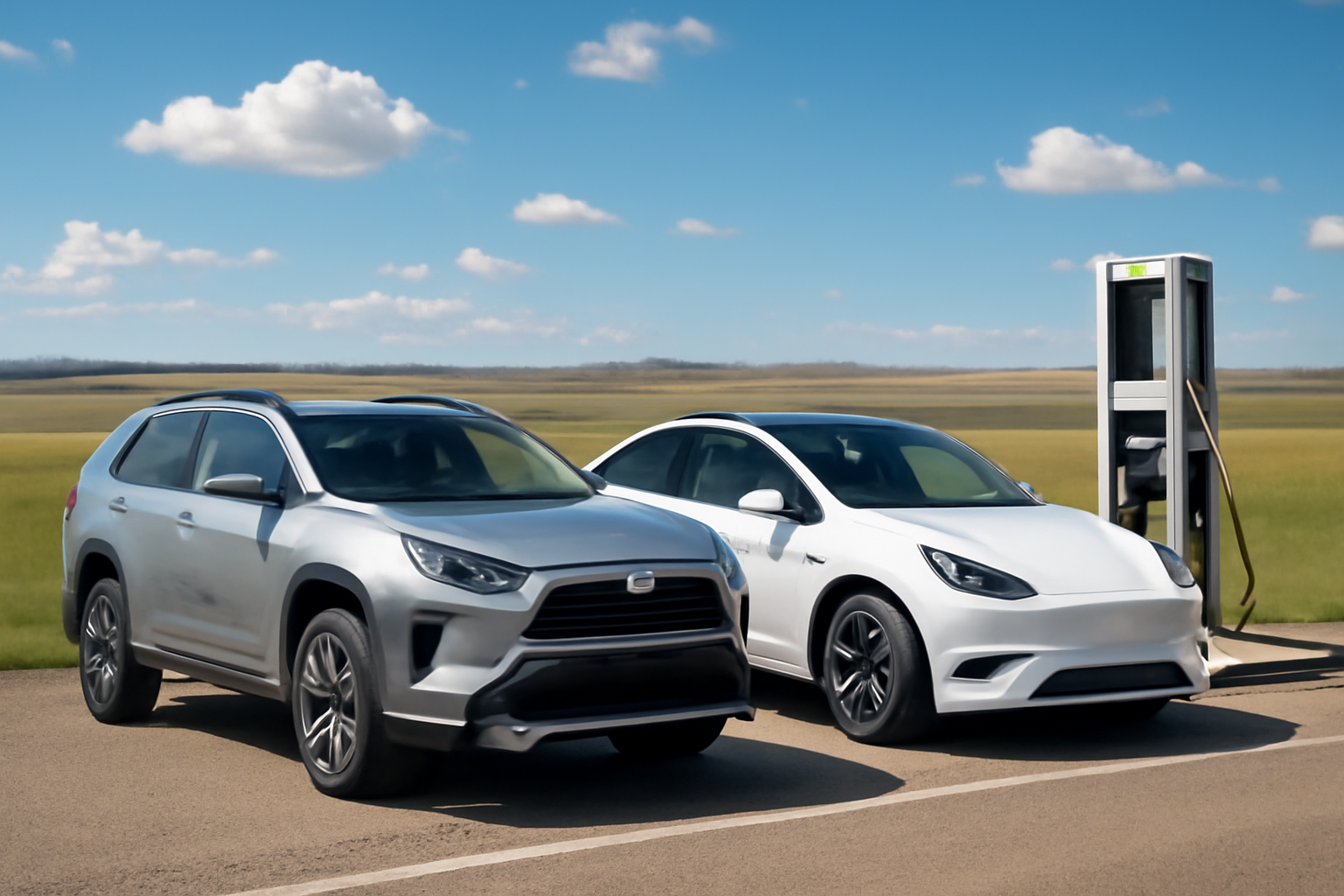
Charging Into Summer: Hybrids vs EVs in Alberta
Ready to road-trip greener? Here’s the real Alberta scoop.
Picture this: the tent is packed, the playlist is queued, and the highway ahead is pure prairie horizon. You want your summer road trip to be cleaner and cheaper—but Alberta is big. Distances are long, services can be sparse, and mountain grades aren’t shy. So which fuel-sipping ride makes sense for you: a hybrid, a plug-in hybrid (PHEV), or a full battery electric vehicle (EV)?
Let’s break it down with an Alberta-first lens: highway ranges that match our geography, charging options where you actually drive, and financing paths that work whether you buy new vs used cars through a dealership or from a private seller.
Hybrid, PHEV, or EV: What’s the difference?
Quick refresher for this auto comparison:
- Hybrid (HEV): Gas engine + small battery. The vehicle self-charges while driving. No plugging in, best for drivers who want high fuel economy with zero charging hassle.
- Plug-in Hybrid (PHEV): Larger battery you can plug in. Often 40–80 km of electric-only range for errands or commuting, then hybrid mode for road trips. Great flexibility if you don’t always have charging access en route.
- Battery Electric (EV): 100% electric. Quiet, quick, and low operating costs. Ideal if you can plan charging on longer routes.
Alberta road-trip reality check
Alberta’s summer roads cover everything from long, straight highways to steep mountain passes and windy foothills. You might drive 200–400 km between major stops. Summer is range-friendly for EVs compared to winter, but planning still matters.
- Highway corridors: Trans-Canada (Hwy 1), Yellowhead (Hwy 16), and QEII are the main arteries. DC fast charging is available along major routes, but smaller detours may require Level 2 stops or careful planning.
- Elevation & wind: Headwinds, climbs, and roof boxes reduce efficiency for all vehicles. EVs show it clearly on the dash; hybrids/PHEVs show it at the pump.
- Gravel & access roads: Many lakes and trailheads sit beyond paved routes. Ground clearance and tires matter more than powertrain.
- Summer advantages: Warm batteries mean better EV range and faster DC charging vs winter. Cabin preconditioning can be powered while plugged in to save range.
Side-by-side: Which is best for Alberta summer trips?
Range and refuelling/charging
- Hybrid: 800–1,100 km per tank is common for efficient sedans and crossovers. Refuel anywhere. Easiest option for remote trips or last-minute plans.
- PHEV: 40–80 km on electricity around town, then 700–900 km per tank in hybrid mode. On a road trip, you’ll drive mostly on gas unless you find Level 2 chargers at hotels/campgrounds.
- EV: Typical summer highway range: 300–500+ km depending on model, battery, wheels, and roof cargo. Plan DC fast-charge stops every 200–350 km for comfort. On major corridors, this is increasingly simple if you plan ahead.
Running costs
- Hybrid: Excellent fuel economy, low maintenance. You still pay for gas, but far less of it.
- PHEV: Local driving on electricity is cheap; road trips may look like hybrid fuel costs unless you top up at destinations.
- EV: Home charging is cheapest (often pennies per km). DC fast-charging costs vary by network but are typically below gas on a per‑km basis. Alberta electricity plans differ—fixed vs variable—so check your kWh rate before you budget.
Purchase price, incentives, and taxes
- Incentives: Canada’s federal iZEV program offers up to $5,000 on eligible new EVs and PHEVs (price caps apply). Alberta currently has no provincial rebate; the upside is no provincial sales tax (5% GST only).
- Used market: Alberta has strong demand for efficient crossovers and trucks. Used EVs and PHEVs can offer great value—just verify battery health and charging speeds. Many shoppers begin with terms like “new and used cars Edmonton,” but the same car buying tips apply all over the province.
Cargo, comfort, and towing
- Hybrids: Usually identical cargo space to their gas twins. Some hybrids and PHEVs have reduced cargo floor height due to batteries—check before you buy that roof box, stroller, and cooler all fit.
- PHEVs: Many compact/midsize PHEV SUVs can tow 1,000–1,500 kg when properly equipped—enough for a small trailer or a couple of kayaks on a small utility trailer. Expect reduced efficiency while towing.
- EVs: Increasingly tow-capable. Expect faster range drops with trailers (aerodynamic drag matters). For frequent towing across long distances, hybrids or PHEVs provide simpler logistics.
Maintenance and reliability
- Hybrid/PHEV: Proven systems, less brake wear thanks to regen braking. You’ll still have engine maintenance, especially if your PHEV runs in hybrid mode on trips.
- EV: Fewer moving parts, no oil changes, and strong regen braking. Watch tire wear on heavy, high‑torque EVs and rotate regularly—especially before and after long trips.
Charging and infrastructure in Alberta
- DC fast charging: Available along major highways and growing each season. Many networks are adding stations along popular tourist routes; check coverage before you go.
- Destination charging: Hotels, attractions, and campgrounds increasingly offer Level 2 (J1772). Always ask for permission and bring your own cable or portable EVSE.
- Apps: Plan with PlugShare or the vehicle’s native route planner. Save backups in case a site is down or busy.
Which powertrain fits your Alberta trip?
If you want zero‑hassle spontaneity
Pick a Hybrid. You’ll drive far, fill up anywhere, and never think about plugs. Great for last‑minute departures, gravel detours, and late‑night arrivals when chargers might be scarce.
If you want weekday electric, weekend freedom
Choose a PHEV. Run errands on electricity during the week and hit the highway in hybrid mode for summer trips. If your hotel or campsite has Level 2, you’ll recapture EV miles overnight.
If you want the quietest, cleanest drive
Go EV. For well-planned routes along major corridors, EVs deliver low running costs, instant torque for mountain passes, and a calm cabin. Build in scenic DC fast-charge stops every few hours to stretch, snack, and swap drivers.
Alberta-specific car buying tips for eco road-trippers
- Check battery health on used EVs/PHEVs: Ask for a battery report or State of Health reading. For models with known fast-charge quirks, verify real‑world speeds.
- Confirm charging connector compatibility: CCS and Tesla (NACS) are common; adapters are expanding. Make sure your road-trip corridor supports your connector.
- Inspect tires and ground clearance: If your route includes gravel approaches to lakes or trailheads, prioritize tougher tires, a spare, and splash protection.
- Roof boxes and racks: Expect range or fuel economy penalties. Keep speeds reasonable and remove boxes when not needed.
- AMVIC and paperwork: Buy from reputable sellers. For out-of-province vehicles, budget for inspections and registration steps unique to Alberta.
- Insurance and roadside: Confirm coverage for trailers and roadside towing for EVs (including flatbed requirements).
Charging smarter on Alberta trips
Home base charging
Level 2 at home (240V) makes EV and PHEV ownership easy. Even a Level 1 (120V) outlet adds overnight range for PHEVs and can keep an EV topped up ahead of departure.
On the road
- DC fast charging: Plan stops near amenities and aim to arrive around 10–20% and leave around 70–80% for the quickest sessions.
- Campgrounds: Many sites offer power, but not all outlets suit EV charging safely. Ask first, use proper adapters, and limit current to avoid tripping breakers. Never run cords across shared paths.
- Backup options: Identify at least one alternate charger per leg. Cell coverage can be spotty; download maps.
Model shortlists to consider (new and used)
This isn’t a full vehicle review, but here are reliable starting points for a car comparison:
- Hybrids: Toyota RAV4 Hybrid, Corolla Hybrid, Camry Hybrid; Honda CR‑V Hybrid, Accord Hybrid; Hyundai Tucson Hybrid; Kia Sportage Hybrid. Solid range per tank, family-friendly cargo.
- PHEVs: Toyota RAV4 Prime, Mitsubishi Outlander PHEV, Ford Escape PHEV, Hyundai Tucson PHEV, Kia Sportage PHEV. Good for mixed driving—electric weekdays, gassed-up weekends.
- EVs: Tesla Model Y/3, Hyundai IONIQ 5/6, Kia EV6, Chevrolet Bolt EUV (used), Volkswagen ID.4, Nissan LEAF (used, note CHAdeMO fast‑charge limitations on some routes). Focus on highway range, charging curve, cargo, and ground clearance for Alberta trips.
If you’re eyeing the used market, battery condition, fast‑charge history, and warranty are key. That’s true whether you search “auto sales Edmonton,” browse a vehicle marketplace Edmonton shoppers use, or stick to a province‑wide open car marketplace.
New vs used cars: what makes sense for summer 2026?
- New: Access to the latest safety tech, improved charging speeds, and potential federal incentives for eligible EVs/PHEVs. Easier to find factory tow ratings and roof-load specs.
- Used: Lower upfront cost and plenty of proven models. For EVs, verify battery and charging health; for PHEVs, ensure the onboard charger and EV modes work as expected.
Budgeting and financing for Alberta buyers
From vehicle financing Canada-wide to local lenders, rates and terms can vary between hybrids, PHEVs, and EVs. Total cost of ownership matters: fuel/energy, maintenance, tires, and potential incentives. If you’re early in the search, you can get pre-approved to set a comfortable budget before test drives. Many eco‑curious buyers also ask about $0 down car loans, especially if they plan to add home charging soon after purchase.
If your credit history is thin or rebuilding, explore options like bad credit car loans or dedicated first time car buyer programs. These can work for both dealership purchases and private sale transactions when arranged through lenders familiar with Alberta titles and AMVIC documentation.
Where to shop and how to compare
When you want both selection and transparency, an open car marketplace is handy. Driving With Us Auto Market lists new and used vehicles from dealerships and also supports private seller cars Alberta drivers are posting all summer. You can cross‑shop hybrids, PHEVs, and EVs side by side, filter by tow rating, cargo space, or fast‑charge speeds, and line up financing for either a dealer purchase or a private sale. If you usually start with terms like “car marketplace Alberta” or “new and used cars Edmonton,” you’ll still see options from across the province in one place.
Trip planning playbook: greener and easier
Before you buy
- Decide your typical trip length and terrain. Prairie weekenders? Any powertrain works. Mountain loops with long detours? Hybrids/PHEVs shine for flexibility; EVs need a plotted charging plan.
- List your gear: strollers, dog crates, coolers, inflatable SUPs. Make sure they fit with the family on board—test-pack if you can.
- Factor in towing now, even if “maybe later.” Not every trim includes a tow rating or the right cooling package.
- Check EnerGuide/NRCan efficiency ratings and real-world owner data for highway speeds with cargo.
After you buy
- Set tire pressures for highway loads and verify your spare or repair kit. Gravel approaches are common.
- For EVs/PHEVs, add charger apps, create accounts, and test a local station before the big trip.
- Precondition the cabin while plugged in before departure to save early kilometres of range.
- Pack a charging kit: gloves, headlamp, microfiber towel (for wet cables), and a backup L2 plan.
Sample Alberta road-trip scenarios
Family of four, tent camping, big cooler
Best fit: Hybrid or PHEV SUV. You’ll get the cargo height and range you need with minimal planning. If your campground has Level 2, a PHEV can top up while you sleep.
Couple chasing hot springs and coffee shops
Best fit: EV crossover. Plan 25–40 minute DC fast-charge breaks every few hours. Enjoy quiet drives and low energy costs, especially if you can destination charge at night.
Solo hiker with a roof box and gravel detours
Best fit: Hybrid hatch or compact SUV. Cheap to run, easy to refuel, and forgiving when plans change or the scenic route calls.
What to double-check on a test drive
- Highway stability and wind noise: Prairie crosswinds are real. Try 100–120 km/h on an open stretch.
- Fast-charge curve (EV): If possible, test a fast charge from ~20% to ~70% and note speed. This matters more than the headline peak kW.
- Seat comfort over time: Do a long loop. Alberta hours are long hours.
- Infotainment and nav: Built-in route planning for chargers can reduce stress in unfamiliar areas.
Cost snapshot: what to expect
- Hybrid: Lowest purchase premium, solid resale. Fuel cost depends on payload, roof gear, and pace.
- PHEV: Slightly higher purchase price; can slash weekday fuel to near zero if you charge at home. Road trips look like efficient hybrid costs.
- EV: Higher purchase price offset by federal incentives (on eligible models), low maintenance, and cheap home charging. DC fast-charging for trips still beats gas per km for many models, but budget for it.
FAQ: Hybrids and EVs for Alberta summer
How much EV range will I lose with a roof box? Expect 10–25% depending on size and speed; hybrids and PHEVs also use more fuel with added drag.
Can I rely on chargers in the mountains? Coverage is improving yearly on major tourist routes. Plan ahead, verify stations the day before, and have a Plan B.
What about wildfire detours? Keep your route flexible. With EVs, try to leave critical zones with at least 30–40% buffer. Hybrids/PHEVs: top up earlier than usual.
Is there a provincial rebate in Alberta? Not at the moment. The federal iZEV program still applies to eligible new vehicles; Alberta’s advantage is no provincial sales tax.
The bottom line: match the car to the map
If your summer is packed with long, remote drives, a hybrid (or a PHEV if you can destination charge) is the worry-free pick. If you’re sticking to major corridors and want the smoothest, quietest trip with the lowest per‑km energy cost, an EV makes every leg feel like a fresh start. Either way, compare real-world highway range, cargo space, and—if relevant—tow ratings before you sign.
Shopping across Alberta? Driving With Us Auto Market brings together dealership inventory and private seller cars in an open car marketplace so you can compare hybrids, PHEVs, and EVs in one place. Line up financing early, filter by the features that matter for your route, and hit the highway with confidence.
Ready to shortlist a few vehicles and map your first stop? Start with budget clarity—get pre-approved—then explore flexible options like $0 down car loans, specialized first time car buyer programs, or bad credit car loans designed to help Alberta drivers move forward this summer.