Watt-Ready Workhorses: Alberta’s Best Electric Pickups
Are electric pickups tough enough for Alberta?
Picture this: it’s a frigid dawn, your truck is packed for a weekend in the foothills, and the thermometer is doing that slow drop to minus-30. You need real range, real traction, and real cargo capability—no excuses. Good news: today’s electric pickups can deliver all that, with instant torque for snowy starts, quiet highway cruising across prairie crosswinds, and enough outlet power to run tools at a remote site. The trick is choosing the right truck and setting it up for our province’s unique mix of weather, distances, and roads.
The short list: Alberta-friendly electric pickups
These models are the strongest fits right now for life in Alberta, balancing winter performance, charging practicality, and truck-worthy capability. Always confirm final Canadian specs by trim and model year—range, towing, and payload can vary.
Ford F-150 Lightning
- Why it suits Alberta: Familiar full-size packaging, excellent low-speed traction in snow thanks to instant torque and all-wheel drive, and a frunk that keeps gear clean and warm. Many trims include bed outlets and vehicle-to-load power—handy for job sites, camping, or powering block heaters and tools.
- Range & towing reality: Extended-range versions can handle typical Alberta commutes easily. Expect noticeable winter and towing penalties; plan conservative buffers (more on that below).
- Service & parts: Broad dealer network and strong aftermarket support make ownership straightforward across the province.
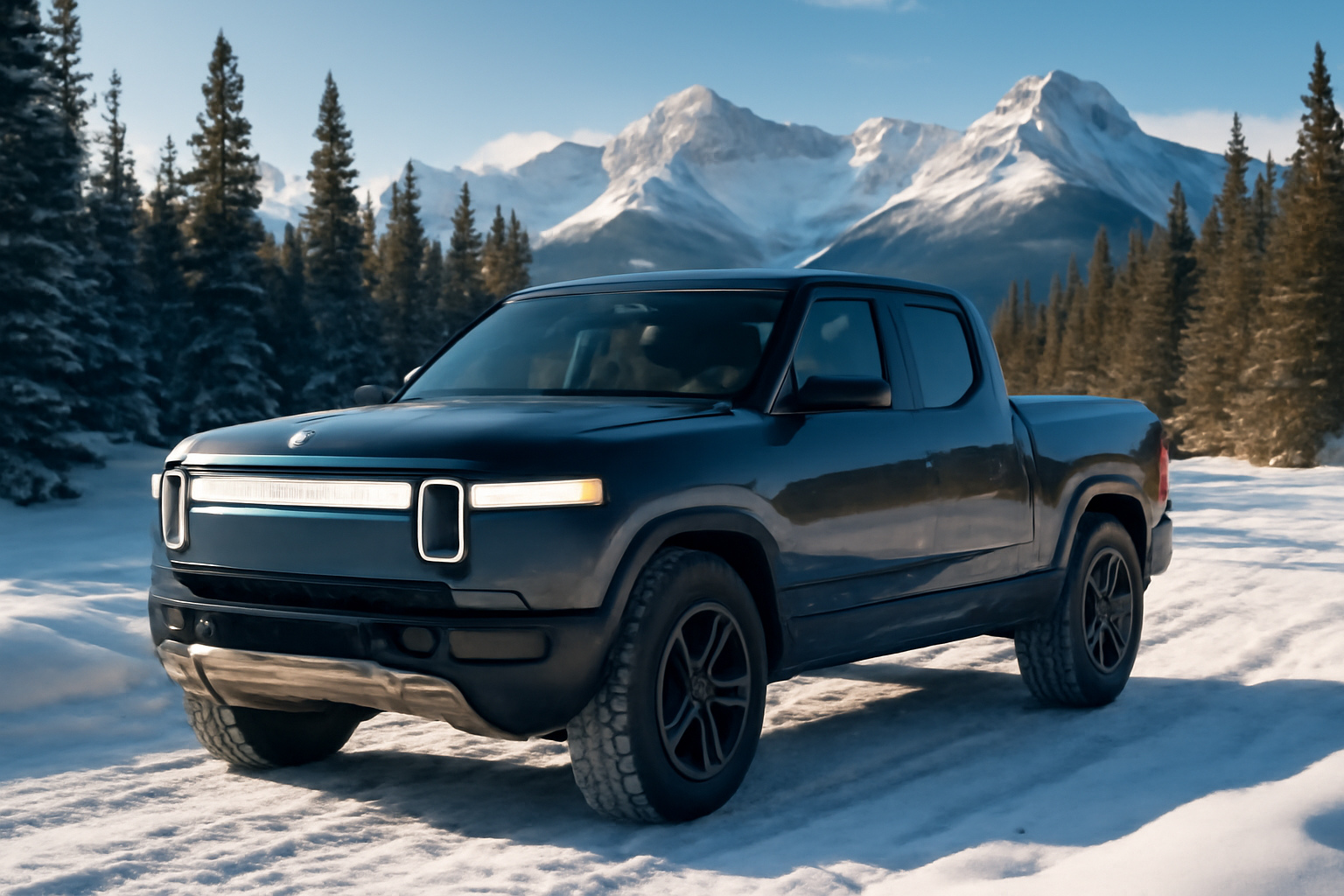
Rivian R1T
- Why it suits Alberta: Purpose-built for adventure with strong off-road modes, adjustable air suspension, and clever storage (gear tunnel). Excellent for backroads, trailheads, and mixed-use weeks.
- Range & towing reality: Higher-capacity battery options push highway range well into comfortable territory; just remember cold + speed + headwinds will trim that quickly on open prairie.
- Ownership notes: Direct support in Canada continues to grow; confirm proximity to approved service options before you buy if you’re based far from major centres.
Chevrolet Silverado EV
- Why it suits Alberta: Long-range estimates on select trims, big-bed utility, and available midgate flexibility for hauling sleds or lumber. Ultium platform supports fast DC charging for corridor travel.
- Range & towing reality: Strong on-paper range for long stretches. Towing performance is competitive; just plan your charging stops where trailer-friendly pull-through stations exist.
- Service & parts: Backed by GM’s national network; good for drivers who want mainstream support.
GMC Sierra EV
- Why it suits Alberta: Denali-level comfort for all-season daily driving, with Ultium-based charging performance and the same midgate versatility as its Chevy sibling.
- Range & towing reality: Similar considerations to Silverado EV: strong highway legs, but be smart about winter buffers and trailer aerodynamics.
GMC Hummer EV Pickup (niche pick)
- Why it suits Alberta: Extreme off-road capability, adjustable suspension, and rugged underbody protection for rough sites and seasonal backroads.
- Trade-offs: Heavy, wide, and not the most efficient—think specialty use rather than everyday frugality. Charging logistics require a bit more planning.
On the horizon
Watch for upcoming models like the Ram 1500 REV and Ram 1500 Ramcharger (a range-extended plug-in approach). If your timeline is flexible, these could broaden your options, especially for longer-haul Alberta driving.
How to pick the right electric truck for Alberta
1) Range that fits real winter use
Cold saps battery efficiency. In Alberta winters, assume a 20–40% range reduction in typical cold and potentially more in deep-freeze conditions or during blizzards with strong headwinds. If your round-trip is 200 km and you can’t reliably charge mid-way, aim for a truck with a rated range of at least 350–450 km for comfortable buffers.
2) Towing and payload math
- Light to moderate towing (e.g., sled trailer, small camper): Expect 30–50% range reduction depending on speed and wind.
- Heavy/boxy trailers: Plan for 40–60% or more. Aerodynamics matter as much as weight.
- Pro tip: Soft tonneau covers and careful load placement help efficiency. Roof racks and tall cargo can hurt range noticeably.
3) Charging access where you actually drive
- Home: A Level 2 (240V) charger is game-changing. Most owners do 80–90% of charging at home. Expect typical install costs of roughly $800–$1,500 in Alberta (every house is different—get quotes from a licensed electrician and secure the proper permit).
- Road trips: Plan with major corridors in mind. Alberta has a growing mix of CCS fast chargers from national networks; more sites keep coming online. If your truck supports very fast charging (e.g., 200–350 kW), you’ll shorten stop times significantly.
- Connectors: Many current trucks use CCS. Some brands are transitioning to North American Charging Standard (NACS) support and adapters—check your model’s timeline.
- Trailers: Choose pull-through fast chargers when possible; otherwise, plan to unhook briefly.
4) Winter hardware and software
- Thermal management: Trucks with robust battery heating and cabin preconditioning are worth it here. Precondition before leaving to preserve range and comfort.
- Tires: Get proper winter tires carrying the mountain/snowflake symbol. Studded tires are legal in Alberta—handy for ice-prone rural roads.
- Ground clearance & underbody protection: Helpful for rutted access roads and spring thaw conditions.
5) Warranty and service
Most EV batteries in Canada carry 8-year/160,000 km (or better) warranties. Confirm coverage details, what’s considered normal degradation, and where warranty service is performed.
Real-world Alberta examples
- Work commute + errands (120 km/day round trip, mixed highway): Any of the trucks above will handle this comfortably with home Level 2 charging, even in winter. Schedule a 15–20 minute DC fast charge only on unusually cold or windy days.
- Weekend towing (1,500–3,000 kg camper): Expect to stop for DC fast charging every 150–250 km depending on truck, weather, and trailer shape. Precondition your battery en route to the charger for faster top-ups.
- Rural properties: If you’re far from fast charging, size up the battery and prioritize reliable home charging. Many barns/shops already have 240V circuits that can be adapted for EVSE with proper permits.
Charging smarter in Alberta
Alberta’s deregulated electricity market means you may be able to pick a retailer and plan that rewards off-peak use. Even without formal time-of-use, you can still save by charging overnight when demand is lower. A few tips:
- Set a daily charge limit (often 70–80%) for routine use; go to 90–100% before a big trip.
- Precondition the battery and cabin while plugged in—warm starts use less energy.
- Keep the battery warm in severe cold by parking indoors or using scheduled departure features.
- Plan B: RV parks with NEMA 14-50 outlets can be useful shoulder-season charging options; always ask permission and use appropriate adapters/settings.
Cost of ownership: what to expect
Energy costs: A typical electric pickup might average 28–35 kWh/100 km in mild weather and 40–55 kWh/100 km in deep winter. At $0.18/kWh all-in (example only), that’s roughly $5–$6 per 100 km in summer and $7–$10 in winter—often below a comparable gas truck, especially with city driving and idling avoided.
Maintenance: No oil changes, fewer moving parts, and strong regenerative braking reduce wear. Still budget for tires (trucks are heavy; winter sets are worth it), cabin air filters, brake servicing, coolant for the battery thermal system per manufacturer schedule, and alignment if you hit rough roads frequently.
Incentives: At the time of writing, Alberta does not offer a provincial EV rebate. Federal iZEV incentives exist but many electric pickups exceed the price caps—check current eligibility before you buy.
New vs. used: making the right call in Alberta
Buying used can be a smart way to get into an electric pickup, especially if you don’t need the newest battery tech. When comparing listings on an open car marketplace or private seller cars in Alberta, use this quick checklist:
Used EV truck checklist (Alberta-ready)
- Battery health: Ask for a battery state-of-health report or service printout. Moderate degradation is normal; dramatic drops are a red flag.
- Charging history: Frequent DC fast charging isn’t a deal-breaker, but a balanced diet of home Level 2 is gentler on batteries.
- Thermal system: Confirm no active warnings and that preconditioning works; winter comfort and range depend on it.
- Underbody & suspension: Check for off-road scrapes, rust on fasteners, and bushing wear from rough roads.
- Tires: Budget for a proper winter set if one isn’t included.
- Software & cameras: Confirm driver-assist features calibrate properly after any prior windshield/bumper repairs.
- Vehicle inspection: Get a third-party EV-savvy inspection before you commit. A thorough vehicle inspection is still essential on electric trucks.
- History: Review accident records, outstanding recalls, lien status, and warranty transferability.
When you’re browsing the broader market—whether dealership inventory or private listings—an open marketplace like Driving With Us Auto Market makes it simple to compare new and used options in one place. Our open marketplace connects buyers and private sellers across Alberta, and we can arrange financing even for private-sale EV trucks.
Financing an electric pickup
Electric trucks can carry higher MSRPs, but flexible financing and total cost of ownership can level the field. Start with a budget and pre-approval so you can move quickly on the right truck:
- Lock in your rate and know your ceiling before you shop: get pre-approved.
- Minimize upfront costs if needed with $0 down car loans (subject to approval).
- Building or rebuilding credit? Explore options for bad credit car loans.
- New to Canada and need a work-ready vehicle? Check car loans for new immigrants.
At Driving With Us Auto Market, we finance both dealership inventory and private-sale purchases, which is handy when a great used EV truck pops up from a private seller. Because EV residual values and incentives evolve, it also pays to revisit rates down the road; if your situation improves, consider auto loan refinancing.
Test-drive checklist for Alberta conditions
- Cabin preheat: Use the app to precondition; check how quickly the cabin warms and windows defog.
- Snow/ice takeoff: Test smooth throttle modulation and traction control on a safe, slick surface.
- Highway crosswinds: Alberta winds can be no joke—listen for noise, feel for stability, and watch consumption at 100–110 km/h.
- One-pedal driving: Ensure regen strength feels natural; it’s great for control on packed snow when used gently.
- Driver assists: Try lane-keeping, adaptive cruise, and surround cameras. Winter-friendly visibility tools are worth their weight.
- Power export: If offered (e.g., bed/in-cab outlets), test with a tool or heater—perfect for campsites, tailgates, or remote job sites.
Pro setup tips for Alberta owners
- Install Level 2 early: A 40A circuit (or as recommended by your electrician and truck specs) hits the sweet spot for overnight replenishment.
- Winter wheels: Dedicated winters with the mountain/snowflake rating. Studs are legal if you need extra bite on ice.
- Charge planning apps: Keep two or three apps on your phone; redundancy is your friend when temps plunge.
- Trailer profile: If your truck lets you add trailer profiles, do it—better range predictions, better charging stops.
- Precondition en route: Many trucks can warm the battery automatically when you navigate to a fast charger; it can cut winter charging times substantially.
Shopping the Alberta market (and keeping it broad)
When comparing prices, you’ll see search results across the province and beyond—terms like “used trucks Edmonton,” “auto sales Edmonton,” “vehicle marketplace Edmonton,” and “best used cars Edmonton” are common even if you’re browsing from elsewhere in Alberta. Use them to cast a wider net, but always compare VIN-by-VIN and review condition reports and history. On an open car marketplace, filter by battery size, tow rating, and fast-charging speed—not just trim names—so you’re comparing apples to apples. If you plan to buy a used car in Alberta, bring a proper used car checklist and book an independent inspection before money changes hands.
FAQs for Alberta EV truck buyers
Do EV pickups hold up in deep cold?
Yes—with planning. Preheating, winter tires, and realistic range buffers make a big difference. Once the battery and cabin are up to temp, daily driving is smooth and predictable.
How long do they take to charge?
On Level 2 at home, many trucks add 30–45 km of range per hour. On a 150–350 kW DC fast charger, expect 20–45 minutes for a substantial top-up, longer in severe cold if the battery isn’t preconditioned.
Can I power tools or my home from the truck?
Some electric pickups offer 120V/240V outlets and even limited home backup capability with the right hardware. It’s great for remote work or shoulder-season campgrounds. Check trim specifics.
Is financing different for EVs?
Not fundamentally. Rates depend on credit, loan term, and vehicle age. Start early to get pre-approved and consider options like $0 down car loans if cash flow matters. Buyers rebuilding credit can explore bad credit car loans; newcomers can look at car loans for new immigrants.
Final take: the right electric pickup for Alberta
Electric pickups aren’t just for coastal commutes anymore—they’re ready for Alberta’s mix of gravel, snow, wind, and long straight highways. The Ford F-150 Lightning, Rivian R1T, Chevrolet Silverado EV, and GMC Sierra EV offer the best blend of range, charging, and real truck capability today, while niche choices like the Hummer EV serve specialized needs. Size your battery to your routes, get winter tires, install a solid Level 2 at home, and plan realistic charging stops for towing days.
If you’re weighing new and used options, Driving With Us Auto Market brings dealership inventory and private seller listings together in one open marketplace—plus financing for both, so you don’t have to compromise on the right truck. However you shop, bring this Alberta-focused car buying guide with you, and you’ll be miles ahead—quietly, efficiently, and ready for whatever the weather throws at you.